
Although his name has never been said with the kind of reverence reserved for Liu Chia-Liang, King Hu and Chang Cheh, Joseph Kuo deserves an honourable mention in the annals of kung fu cinema. Perhaps his films haven’t always had the polish or substance of the aforementioned auteurs, but he’s certainly been responsible for some genre classics. Fans of independent martial arts cinema will doubtless know his many significant efforts, including ‘The Mystery of Chess Boxing’, ‘The 7 Grandmasters’ and ‘Dragon’s Claws’, to name but a few. With such a pedigree, it was therefore obvious that Kuo would also have utilised one of the genre’s constant themes: the destruction of the Shaolin Temple and the eventual fightback by the fighting monks.
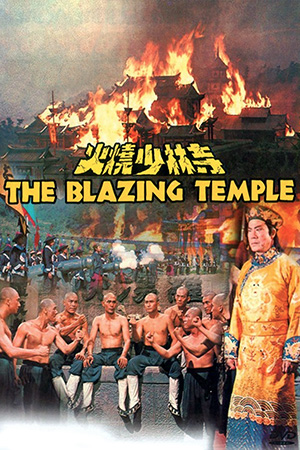
‘The Blazing Temple’ opens with the emperor being informed of supposed events within Shaolin. According to his source, the religious order is training anti-Manchu forces to overthrow the unpopular monarchy. With this in mind, he plots a vicious attack on the temple and the elimination of all of the monks therein. Within Shaolin, the assembled order are unaware of what awaits them and concentrate on their training to pass the test of the Bronzemen. In fearsome manner, the Manchu forces attack the temple and bombard it with constant cannon fire. Most of the monks are killed in the relentless attack, but a band of them manage to escape via a forgotten tunnel out of the grounds. Now the survivors must plan their revenge and their proposed assassination of the ruthless emperor. However, this is brought into question when they find themselves hunted by their enemies and must also face the prospect of having a traitor in their ranks.
There’s much to enjoy in this entertaining kung fu drama, though it can hardly be ranked among the director’s best. It is certainly absorbing to see a narrative that takes in the actual destruction of the temple rather than use it as the catalyst for the rest of the storyline. The lengthy middle section that actually features this is, in fact, the production’s major strength, as Kuo manages to make a modest budget look impressive. ‘The Blazing Temple’ also features a number of kung fu cinema’s bit-part players giving good performances, namely Kam Kong and Chan Siu-Pang. Working against these virtues are a few factors which mean that this is good rather than above average. Importantly, the choreography is not too impressive, especially when one looks at some of the films that came out in the same year. The fight scenes, with the exception of the excellent finale, tend to concentrate too much on gimmicky jumping and flipping rather than the actual skill of the protagonist. Another thing that quickly comes across is that the Shaolin monks – who are the heroes of the piece – are not averse to some harsh actions themselves. Instead of simply leaving the temple when the bombardment begins, the students still have to overcome a final test with the threat of death looming should they fail. Overall, then, ‘The Blazing Temple’ is not Joseph Kuo’s best, nor is it near his very pinnacle. It does, though, offer some solid enjoyment for patient viewers.